
Daily Routines
Overview
Daily routine is where responsibility becomes visible. These animals are here because of human choice, and that choice carries obligations that do not pause for weather, fatigue, illness, or inconvenience. Care happens whether the day is ordinary or disrupted, predictable or difficult. Routine is not maintained for efficiency or comfort, but because living animals depend on regular attention, and because disruption carries consequences that accumulate quietly over time.
This page documents how daily care unfolds in our setting: how attention is structured, how priorities are ordered, and how observation is woven into ordinary movement through the farm. It does not present a schedule, a checklist, or a method to be copied elsewhere. It records what we do, and why, in the context of animals whose needs are shaped by biology, social structure, and environment rather than human preference.
Twice Daily, At Minimum
Care occurs at least twice daily, every day. Morning and evening routines anchor the day and provide regular points of contact with each herd. These moments are not interchangeable or optional; they are the baseline against which everything else is measured.
During severe weather, kidding periods, or periods of closer observation, care occurs more frequently. Increased attention is treated as a natural response to increased need, not as an exception or a disruption of routine.
Routine does not mean rigidity. It means showing up consistently enough that change can be recognized when it occurs.
Weather Does Not Cancel Care
Weather shapes how care is carried out, but it does not determine whether care occurs. Rain, heat, snow, ice, wind, and extreme cold all alter how animals move, rest, and eat. Those conditions increase the importance of presence rather than diminish it.
In difficult weather:
- Checks are more frequent, not fewer
- Observation becomes narrower and more focused
- Movement through the farm slows
Order Reflects Vulnerability
The order in which animals are seen matters.
Mammals are cared for before poultry. Within mammal groups, animals with the least physiological margin are seen first: the young, the old, and those who are ill or recovering. Healthy adults are seen afterward.
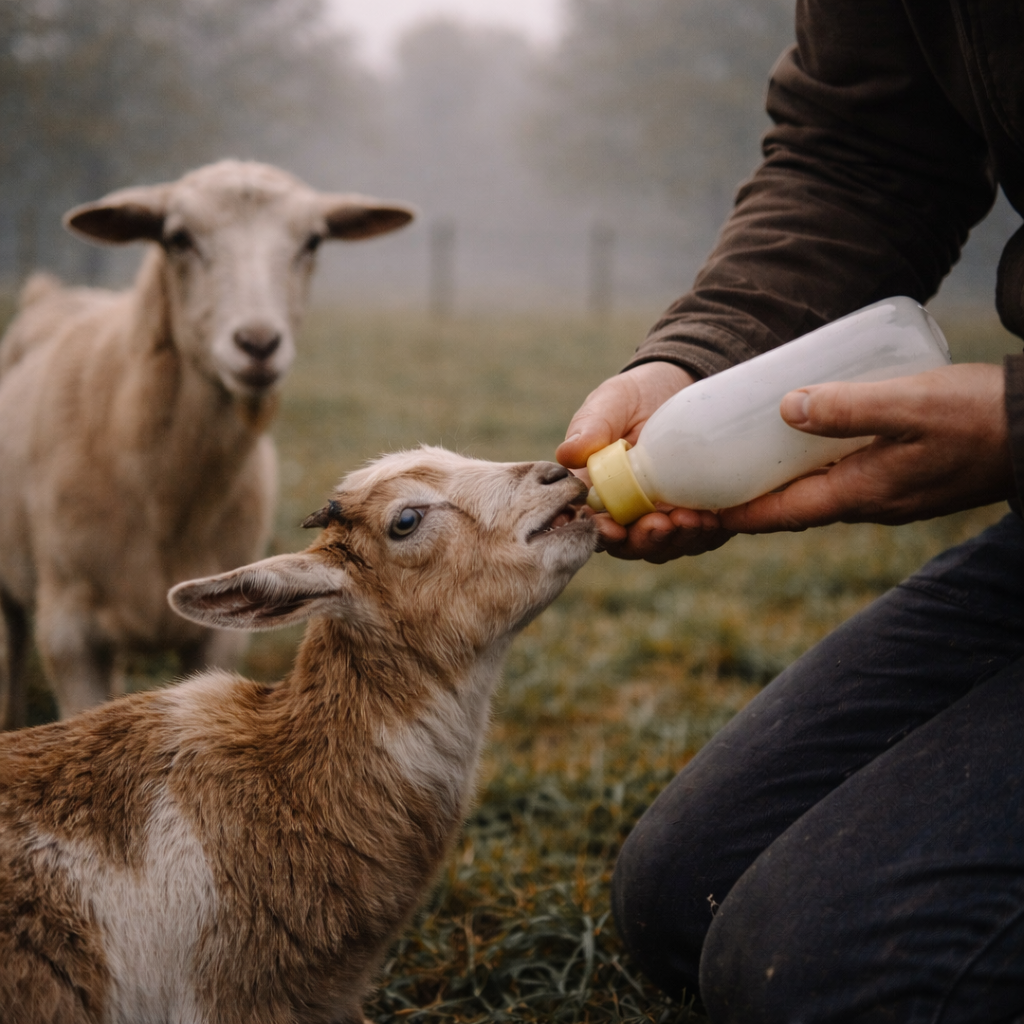
This ordering reflects vulnerability, not hierarchy or convenience. Young animals have limited reserves. Older animals may compensate less easily. Ill animals require closer attention because small changes can carry greater consequence.
This order is maintained consistently so that it becomes automatic rather than deliberative. Decisions made repeatedly become habits; habits shape outcomes.
Herds Are Encountered Separately
Each herd is encountered as its own unit. Movement between herds during daily care is deliberate rather than casual. Tools, buckets, feeders, and handling equipment remain associated with specific herds and spaces.
This separation is not treated as an active intervention. It is part of how the environment remains legible to the animals and to the people caring for them. When each herd is approached in the same way, with the same equipment, in the same order, routines remain predictable and social structure remains intact.
Shortcuts erode predictability. Predictability supports calm.
Familiarity as the Basis of Observation
Effective daily care depends on knowing animals well enough that change is immediately visible. Over time, familiarity allows posture, movement, expression, and interaction to be read almost instantly.
A goat that is slightly off does not need to be examined closely to be noticed. It stands differently. It moves with less confidence. It engages less, or too much. These changes register in a split second when familiarity is deep enough.
This kind of noticing cannot be replaced by periodic inspection. It emerges only through repeated, ordinary exposure.
Embedded Observation
Observation is not scheduled separately from routine. It occurs while walking, feeding, opening gates, refilling water, or pausing briefly in pasture.
During each pass through the herds, attention includes:
- Appetite and approach to feed
- Willingness to move with the group
- Body posture at rest
- Position within social space
- Coat condition and overall presence
Quick Physiological Spot Checks
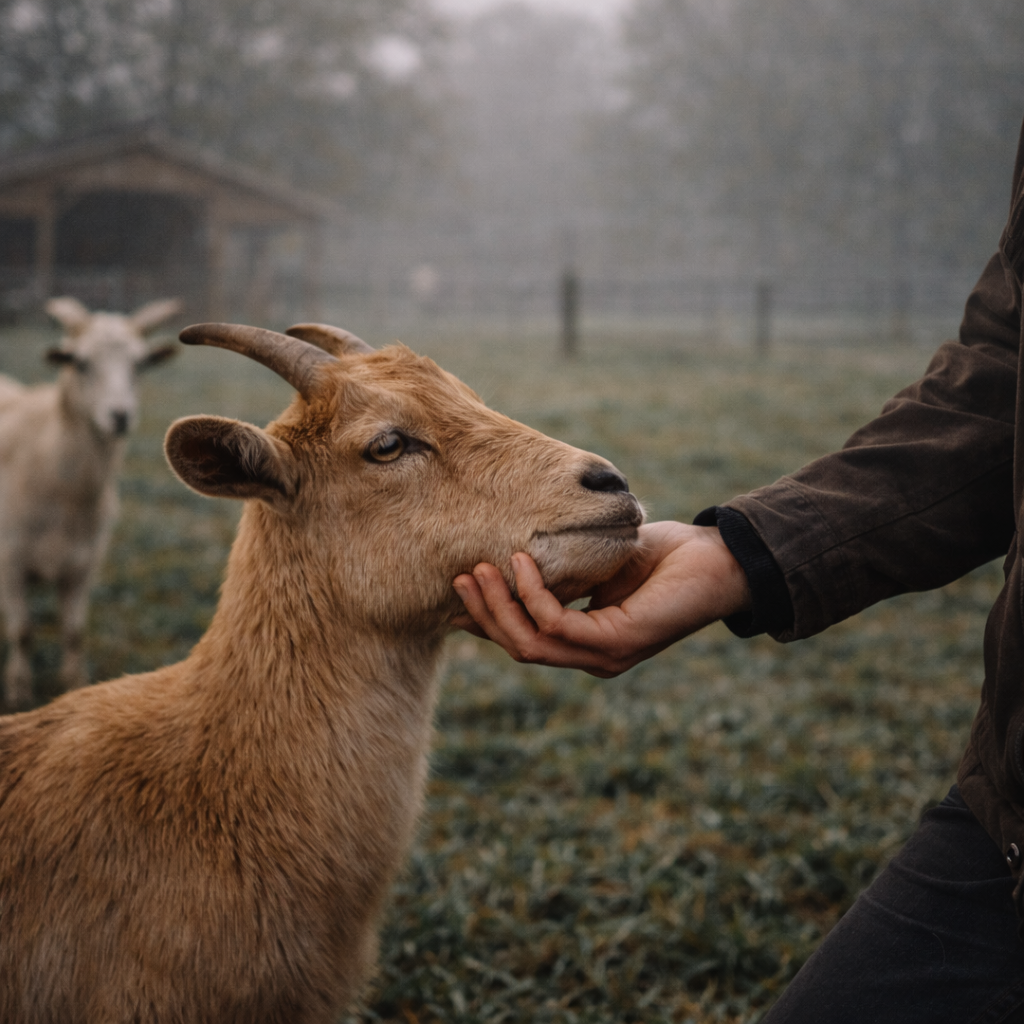
On most days, a small number of animals receive brief, focused attention beyond visual observation. These checks are informal and quick, occurring without restraint or prolonged handling.
They may include noticing:
- Body temperature through touch
- Rumen fill appearance
- Hydration cues
- Subtle stiffness or reluctance
Reading Social Structure
Daily routine provides insight into social dynamics that cannot be captured through records alone.
Goats organize themselves into stable groups, with queens, sub-queens, and lower-ranking individuals forming predictable patterns of association. These patterns become visible only when animals are observed consistently in unstructured moments.
Changes in social position often appear before physical signs of stress or illness. A goat that stops joining a preferred subgroup, lingers at the edges, or becomes unusually assertive is often signaling something worth noting.
Daily routine creates the conditions in which those signals can be seen.
Aligning With Species Rhythms
Care is shaped to align with animal rhythms rather than forcing animals into human schedules.
Goats are crepuscular - their drinking, feeding, and movement patterns often peak in the early morning and evening. Daily routines are structured to intersect with these periods rather than override them.
When routines align with natural rhythms:
- Appetite is easier to assess
- Movement appears more fluid
- Stress responses are reduced
Feeding as Observation
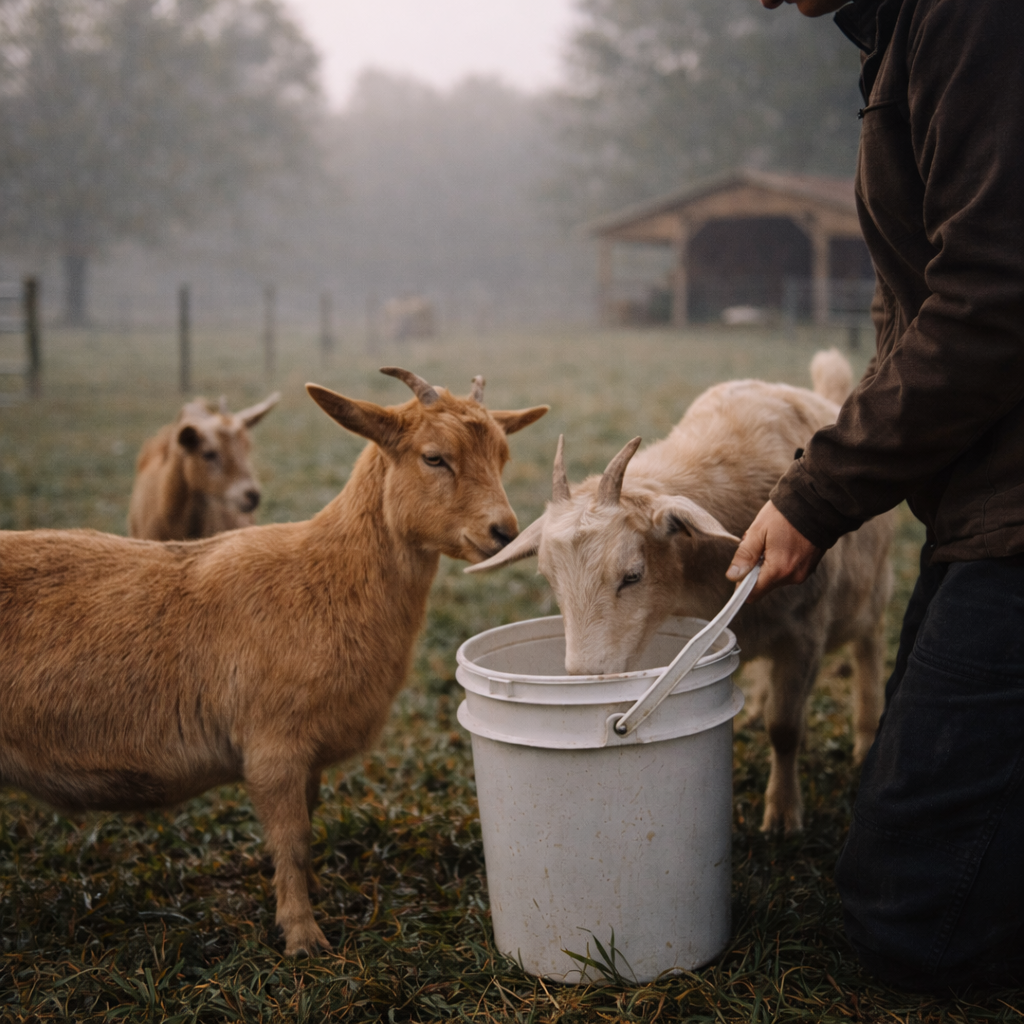
Feeding is never treated as a mechanical task. It is one of the most information-rich moments of the day.
During feeding, attention is paid to:
- Order of approach
- Persistence or hesitation
- Selectivity versus eagerness
- Displacement or avoidance
Water Checks and Use Patterns
Water access is checked at least twice daily. Beyond availability and cleanliness, attention is paid to how goats use water.
Changes in drinking behavior can reflect:
- Weather shifts
- Feed changes
- Early discomfort
Human Hygiene as Routine Courtesy
Human behavior is part of animal care.
Hand washing is routine before and after close contact. Clothing worn off property is not worn directly into herd spaces. On-property clothing becomes familiar to animals through repetition.
These practices are not framed as protective measures but as courtesies that reduce disruption. Familiar scents, textures, and movements contribute to calm interactions.
Limiting Visitors
Visitors introduce novelty. Novelty disrupts routine.
For that reason, visitors are limited, and their presence is managed carefully. When visitors are present, animals are observed for changes in behavior during and after the visit.
The goal is not isolation but continuity. Animals that experience a stable environment day after day are easier to read when something changes.
When Something Is "Off"
Daily routine makes it possible to notice when something is off before it becomes obvious.
When a change is noticed:
- It is noted first
- Context is considered
- Observation increases
Adapting Without Abandoning Structure
There are times when routine must adapt: kidding, illness, weather extremes, or temporary separation. During these periods, care becomes more focused, but structure remains.
Adaptation does not mean chaos. It means adjusting attention while preserving the underlying rhythm of the day.
Once the period passes, routines return to baseline gradually rather than abruptly.
Experience Accumulates Quietly
The ability to read animals quickly is not innate. It accumulates quietly, over years of showing up consistently.
Daily routine is where that experience is built:
- Through repetition
- Through mistakes corrected over time
- Through learning individual animals deeply
Ethical Commitment
At its core, daily routine reflects an ethical stance.
If it is our choice to keep these animals, then it is our responsibility to provide the best care we can, every day. That responsibility does not depend on mood, weather, or convenience. It is not transactional or conditional.
Routine is the structure that makes that responsibility manageable, sustainable, and visible.
Scope & Limits
What is described here reflects our setting, our herds, and our experience. Other contexts may require different routines or priorities.
This page documents what daily care looks like for us. It does not instruct others on how to structure their own routines.