Goat Care Overview
Overview
Goat care is often described as a collection of tasks: feeding, fencing, trimming, breeding, treating, repairing. In practice, those tasks are only the visible surface of a much deeper system shaped by land, time, animals, and constraint. This site exists to document how goat care unfolds in one specific setting, over years rather than seasons, and how decisions emerge from observation rather than prescription.
The pages that follow do not attempt to define best practices, optimize outcomes, or standardize methods. Instead, they record how care is structured here, why certain choices were made, and how those choices interact with one another. Goats do not experience feeding, housing, health, or breeding as separate categories; they experience a continuous environment. This site is organized by topic for clarity, but the underlying reality is integrated and cumulative.
A Record of Practice, Not Instruction
Everything documented here reflects what has worked, changed, or been reconsidered in this particular environment. Climate, pasture composition, herd size, breed mix, labor availability, and long-term goals all shape care in ways that cannot be meaningfully separated from place. For that reason, this site is written as a record of practice rather than a guide to follow.
Descriptions emphasize what is done and why, not what should be done elsewhere. Where uncertainty exists, it is left visible rather than smoothed over. Professional veterinary care, local regulations, and individual circumstances always take precedence over anything written here.
Why the Site Is Organized by Topic
Although care is continuous, it is helpful to slow down and examine individual components. Each topic page focuses on one aspect of goat care while acknowledging its connections to the rest of the system.
- Breeds provides context for the goats present here, not as rankings or recommendations, but as a way to understand differences in size, behavior, feeding patterns, and social dynamics that influence daily care.
- Daily Routines documents how attention is structured across the day and across seasons, and why consistency matters more than efficiency.
- Feeding & Browse explains how hay, pasture, minerals, and supplements fit together over time, and how feeding choices are adjusted gradually in response to observation.
- Shelter & Space describes how barns, fencing, and pasture layout shape movement, social stability, and stress.
- Health Notes focuses on baselines, patterns, and context rather than symptoms in isolation.
- Breeding & Kids records how breeding decisions are approached with restraint, preparation, and long-term responsibility.
- Equipment treats tools and infrastructure as part of the goats' environment rather than as solutions in themselves.
- Records explains why detailed, long-term documentation matters, and how records support memory rather than replace judgment.
Observation as the Central Skill
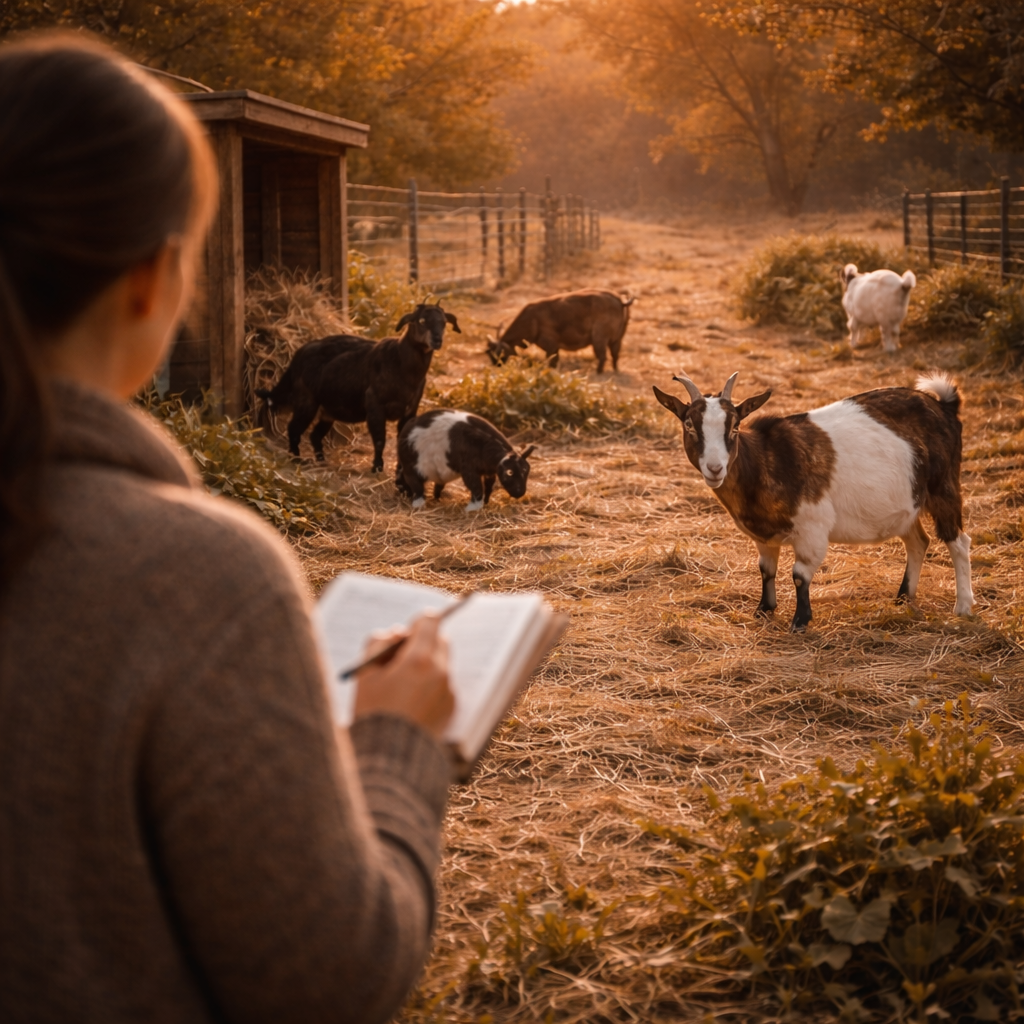
Across all topics, observation is the unifying thread. Most meaningful decisions in goat care are not triggered by emergencies but by subtle shifts: changes in posture, movement, appetite, social spacing, or routine behavior. Those shifts are only visible when animals are seen often enough, in consistent conditions, to establish a baseline.
This site places emphasis on noticing before intervening. That does not mean avoiding action when action is needed; it means grounding action in context. A feeding adjustment, a housing change, or a health concern makes more sense when viewed against months or years of prior observation rather than a single moment.
Constraint Shapes Care
Care here is shaped as much by limitation as by intention. Weather, labor, land capacity, and time all impose boundaries. Rather than treating constraints as problems to overcome, they are treated as realities to work within. Many choices described on this site reflect tradeoffs rather than ideals.
Understanding those constraints helps explain why systems are built the way they are, why some options are intentionally excluded, and why consistency is often prioritized over novelty.
Long-Term Thinking
Goat care is cumulative. Small choices repeated daily shape outcomes more reliably than dramatic interventions. This site reflects a long-term perspective: animals are raised, bred, and cared for with attention to how decisions echo across years rather than weeks.
That long view also explains the emphasis on records, stable routines, and incremental change. Memory fades; written records persist. Habits compound; disruptions accumulate cost. Care improves not by adding complexity, but by refining attention.
How to Use This Site
Readers are encouraged to move slowly through the topics, reading for context rather than instruction. Not every practice described here will be relevant or appropriate elsewhere. The value lies in seeing how systems fit together, how decisions are framed, and how uncertainty is handled honestly.
This site is not a checklist. It is a map of how goat care has been practiced, questioned, adjusted, and sustained over time in one place, with one herd, under real constraints.
Goats deserve care that is thoughtful, consistent, and grounded in reality. This site exists to document how that care is approached here, and why.