Hog Care
Overview
While this site began as a record of our goat care practices, we also maintain similar, species-specific notes for other livestock on the farm. This page documents how we care for hogs in our own setting, using the same observational and descriptive approach.
Hogs are a regular part of our farm, kept in a way that acknowledges both their intelligence and their physical impact on the land. Rather than expecting hogs to behave like grazing animals, we design systems that account for rooting, boundary testing, and strong social dynamics. The goal is not to restrict hog behavior unnecessarily, but to anticipate it and build around it.
We keep hog numbers and group sizes proportional to the land available, with routines designed to remain predictable over time. Much of hog care, in our experience, is less about daily correction and more about preventing pressure from accumulating in the first place. When space, access, and timing are aligned, hogs tend to remain calmer and easier to manage.
Continuity and Long-Term Presence
Hogs have been part of the farm for generations. Historically, a small number were kept to feed the family, integrated into the broader rhythm of the land. That practice has ended. We no longer slaughter hogs, and our current focus is on maintaining breeding stock as a long-term, stable presence.
Today, hogs are kept with continuity in mind rather than short production cycles. They are not treated as temporary occupants of the land, and their management reflects that expectation. By keeping conditions consistent across seasons and years, we reduce stress on both animals and infrastructure and allow patterns to settle naturally.
Breeds and Suitability
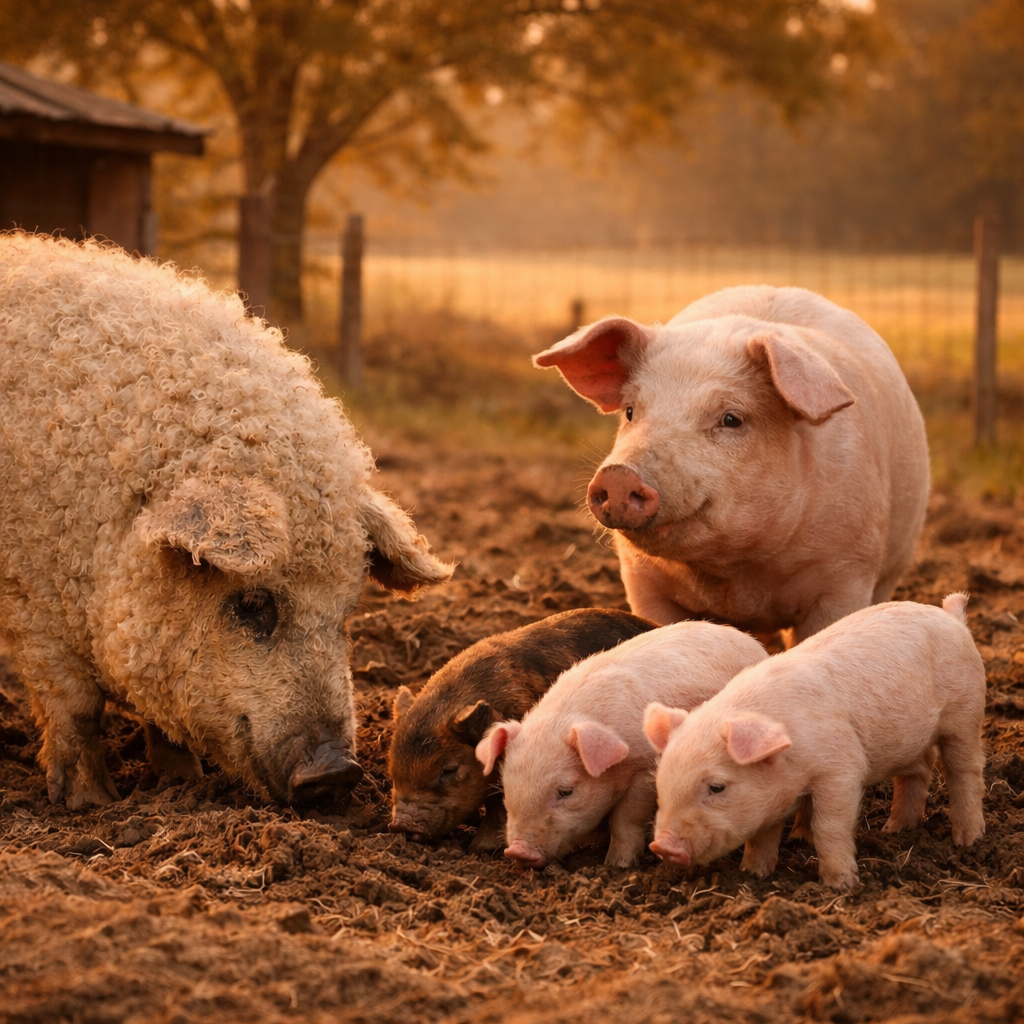
Our hogs are primarily Mangalitsa and Landrace. These breeds were chosen for their resilience, maternal reliability, and ability to remain functional in lower-intensity systems. We favor animals that tolerate environmental variation and routine handling without becoming reactive or difficult to contain.
Selection emphasizes temperament, structural soundness, and adaptability rather than rapid growth or uniformity. Animals that do not remain calm or manageable within the existing system are not forced to fit. Over time, this has helped maintain a herd that is predictable in behavior and easier to integrate into the farm as a whole.
Groups, Behavior, and Movement
Hogs are highly social animals, and group dynamics influence nearly every aspect of their behavior. We keep hogs in stable groups and avoid unnecessary mixing, allowing social order to establish and remain intact. When groups are stable, movement tends to be calmer and less confrontational.
We pay close attention to how hogs move through space, where they concentrate activity, and how they interact with boundaries. Patterns of pacing, rooting, and resting provide useful information about whether space and access remain appropriate. Adjustments are made gradually, with the goal of maintaining predictability rather than enforcing constant change.
Feeding Beyond Pasture
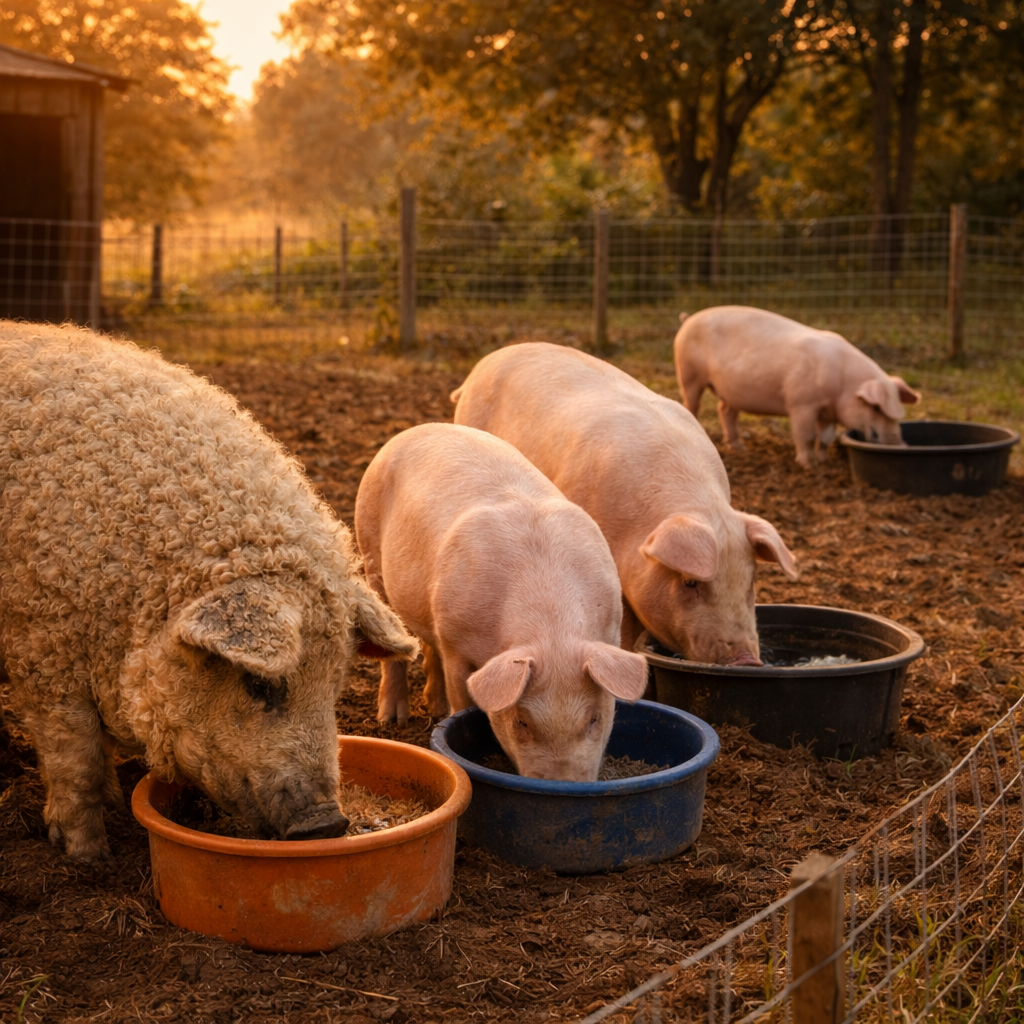
Hogs on the farm receive feed in addition to what they forage naturally. Feeding routines are kept consistent in timing and location, which helps reduce competition and minimizes pressure on containment areas. Sudden changes in feed or schedule are avoided whenever possible.
Feed decisions are made in context, taking into account season, condition, and behavior rather than targets or formulas. By keeping feeding straightforward and predictable, we reduce stress and make daily care easier to maintain over long periods.
Water Access
Reliable access to water is essential for hogs, particularly in warm weather. Water sources are placed and monitored with attention to traffic patterns and ground conditions, as repeated movement to and from water can concentrate pressure quickly.
Seasonal adjustments are made as needed, especially during freezing conditions. These changes are planned to maintain access without creating new problem areas or requiring constant intervention.
Shelter and Weather Response
Hogs are sensitive to both heat and cold, and shelter access plays an important role in how they use space. Shade, wind protection, and dry resting areas are provided so hogs can regulate their own comfort.
We observe how hogs respond to weather rather than forcing uniform behavior. Where animals choose to rest, cluster, or avoid certain areas often provides useful feedback about shelter placement and adequacy.
Daily Routine and Observation
Daily care follows a steady rhythm. Checks are consistent, and observation is prioritized over intervention. Changes in appetite, posture, pacing, or social interaction are often the first indicators that something has shifted.
Because hogs respond strongly to routine, maintaining consistency reduces the need for corrective handling. When adjustments are necessary, they are made gradually, with attention to how the group responds over time.
Handling Philosophy
Handling hogs is approached with restraint. We avoid unnecessary pressure and rely on familiarity, repetition, and calm movement rather than force. Over time, this reduces stress and makes both daily care and occasional handling safer.
Predictability in human behavior matters as much as predictability in physical systems. When hogs know what to expect, they tend to remain calmer and easier to manage.
Land Use, Pressure, and Recovery
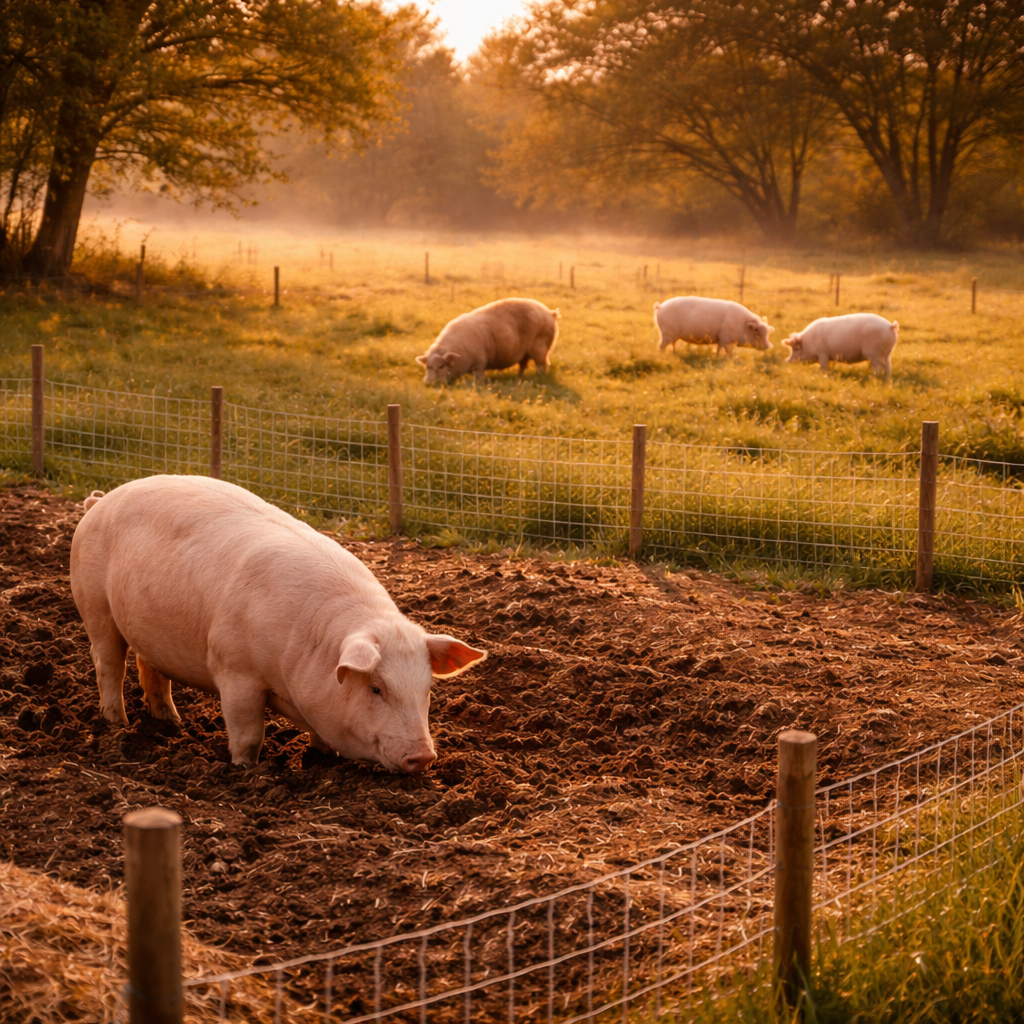
Hogs interact with land differently than grazing species, and their impact can accumulate quickly if access is not limited. We plan hog use with recovery in mind, adjusting access based on ground conditions and vegetation rather than convenience.
Hogs are not maintained on permanent sacrifice areas. Instead, land is given time to recover between uses, and pressure is treated as something to be managed deliberately rather than absorbed indefinitely.
In limited, controlled situations, hogs may be allowed brief access to areas where soil disturbance is useful, such as preparing a new garden space. These uses are bounded in scale and duration, with recovery planned in advance.
Limits and Scope
This page documents how we keep hogs in our own setting. It reflects our land, our scale, and the constraints we work within. It is not a recommendation or a template.
Hogs remain a regular part of the farm, but their role is kept proportional. By setting limits clearly and respecting recovery, we are able to keep hogs integrated into the system without allowing them to dominate it.