Cattle Care
Overview
While this site began as a record of our goat care practices, we also maintain similar, species-specific notes for other livestock on the farm. This page documents how we care for cattle in our own setting, using the same observational and descriptive approach.
Cattle care on this farm is shaped by continuity rather than optimization. The land, the animals, and the routines that connect them have changed gradually over generations, responding to conditions, experience, and long-term observation rather than abrupt shifts in philosophy. What follows documents how cattle are cared for in our setting today, and how that care reflects both inherited patterns and deliberate choices made over time.
This page is a descriptive record of practice. It does not offer instruction, recommendations, or guarantees, and it does not attempt to generalize beyond the context in which these cattle live. Other environments, herds, and goals will require different approaches.
Continuity of Land and Livestock
The relationship between cattle and land here has evolved slowly. Earlier generations focused primarily on crop production, with livestock playing a supporting role. Over time, cattle - particularly dairy-type cattle - became more central, and cropping activity shifted to support animals rather than standing as an independent objective.
That shift did not occur all at once, and it did not replace one system with another. It layered livestock into an existing landscape, reshaping how fields were used, rested, and moved through. Today, cattle are part of an integrated land system in which forage quality, rest, and animal movement inform one another.
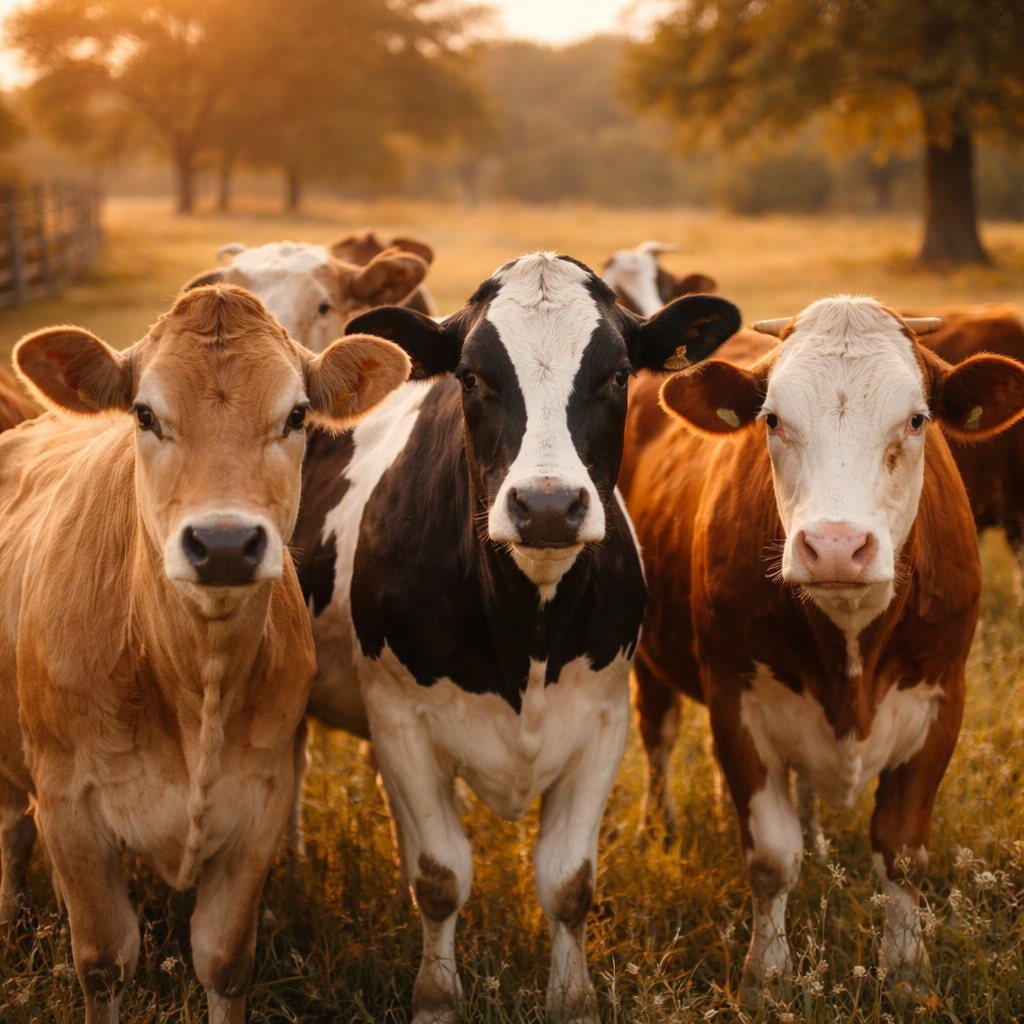
Some cattle in the herd are dairy-type, reflecting that long-standing presence. Others are beef-type cattle who are not managed for slaughter and are allowed to live out their lives as part of the herd. They are not treated as a separate class with different expectations. They are simply cows.
Herd Structure and Grouping
Cattle are managed in multiple groups rather than as a single undifferentiated herd. Grouping reflects age, stage, and social stability, and it changes over time as animals grow and circumstances shift.
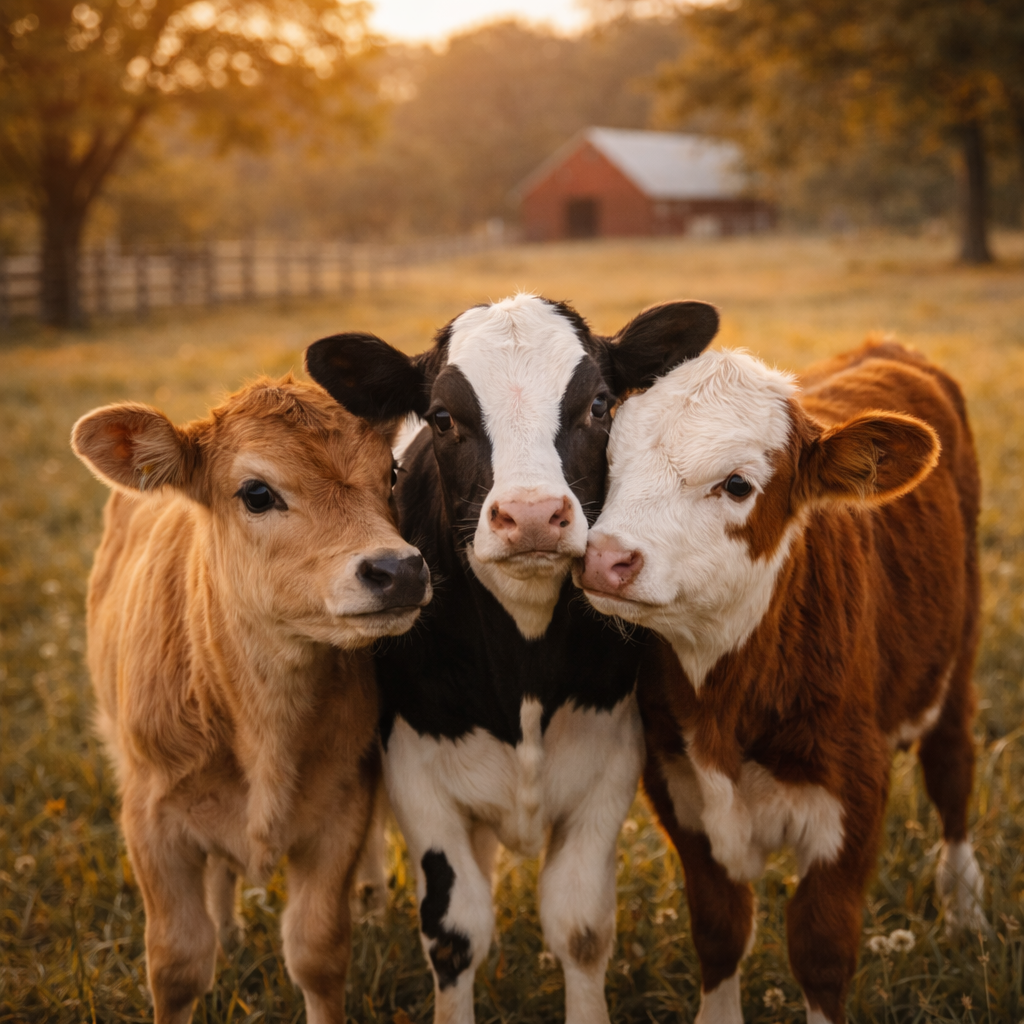
Calves and heifers are managed separately from the main herd for approximately the first six months of life. During this period, cow–calf pairs are separated from the larger group to allow bonding, reduce competition, and support closer observation. This separation is not isolation; it is a quieter context within the broader herd structure.
As animals mature, they are gradually reintegrated into larger groups. These transitions are paced deliberately, allowing social relationships to form without disruption.
Bulls are housed separately from cows and heifers outside of breeding windows. This separation is maintained consistently and forms part of the background structure of herd life rather than an active intervention.
Calves and Early Life
Calves are dam-raised. Early life is oriented around maternal bonding, steady access to milk, and gradual exposure to the broader environment. During the first months, cow–calf pairs remain separate from the main herd, allowing both cows and calves to establish routines without pressure from dominant animals.
Observation during this period is frequent but calm. Attention is paid to nursing behavior, movement, responsiveness, and how calves orient themselves within their immediate group. Most calves integrate smoothly into this structure without intervention.
Occasionally, circumstances require additional support. Bottle calves occur when maternal rejection or health concerns make it necessary. These situations are not routine and are approached as long-term commitments rather than temporary fixes. Bottle-fed calves are cared for as individuals and integrated thoughtfully into herd life over time.
Feeding Beyond Pasture
Pasture is the foundation of cattle nutrition, but it is not treated as sufficient under all conditions. Free-choice hay is always available during winter, drought, or periods of low forage. Hay access is consistent and predictable, allowing cattle to regulate intake without competition or urgency.
Supplemental feed is provided daily but in minimal amounts. It is used to support condition and continuity rather than to drive production outcomes. Feed changes are made gradually and in response to observed need rather than fixed schedules.
Free-choice mineral access is provided consistently. Mineral intake is observed indirectly through behavior and condition rather than measured or managed aggressively.
Feeding is treated as both nourishment and observation. How cattle approach feed, the order in which they eat, and changes in appetite all provide information that is folded into broader health notes.
Water Access
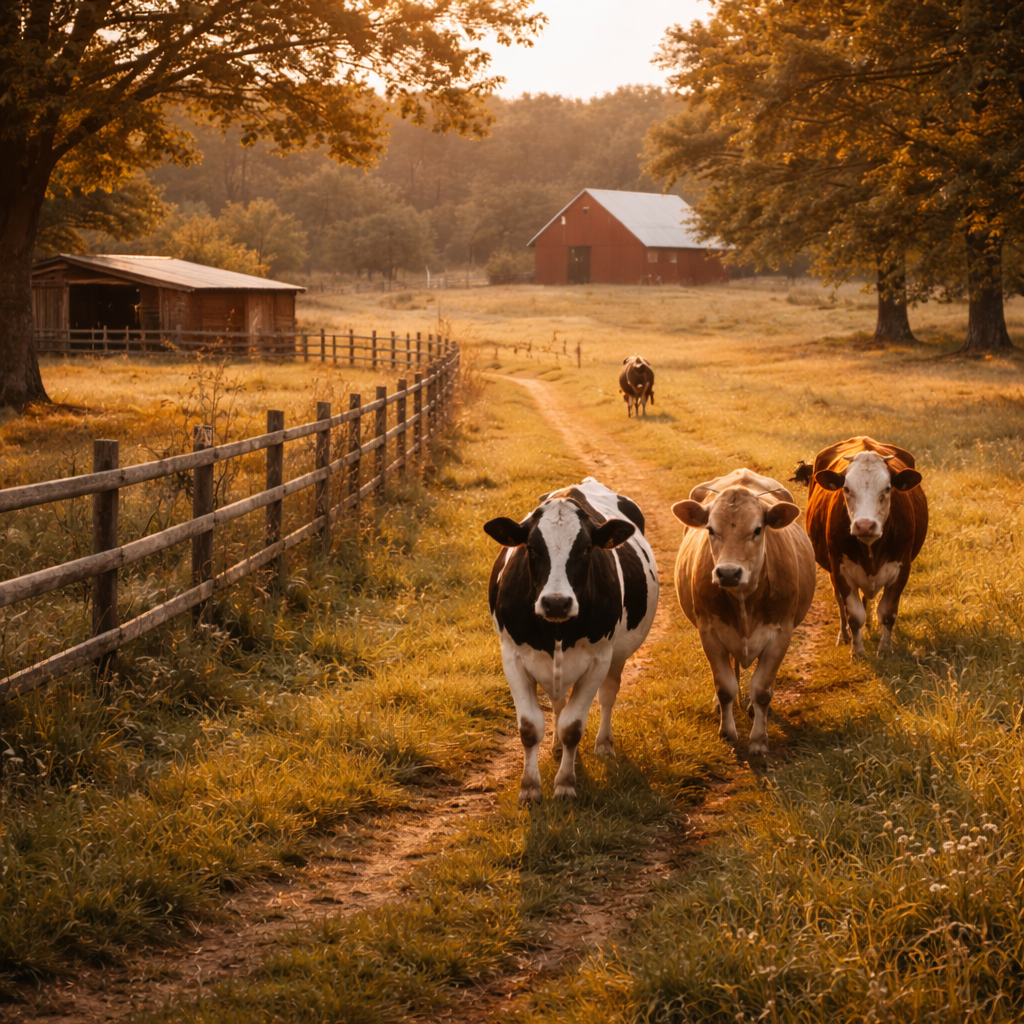
Cattle drink primarily from ponds and creeks, depending on pasture. Water access is shaped by landscape rather than infrastructure wherever possible. These sources are familiar to the animals and integrated into their movement patterns.
During cold weather, when temperatures fall to approximately 20°F or below, water is provided indoors. This adjustment is made to maintain access and prevent disruption rather than to impose confinement. When necessary, cattle are moved to different pastures specifically to ensure barn access during severe cold.
Water use is observed as part of daily routine. Changes in drinking behavior are noted alongside weather, feed, and movement patterns.
Shelter and Weather Response
Cattle have access to a combination of shelter types, depending on pasture: run-in sheds, barns, and natural windbreaks such as tree lines and terrain. Shelter is distributed across the landscape rather than centralized, allowing cattle to choose where to rest based on conditions.
When temperatures drop to around 20°F or below, barn access is provided, even if that requires moving cattle to a different pasture. Shelter decisions are driven by conditions rather than convenience.
During severe weather - extreme cold, heat, or storms - care frequency increases. Animals are checked more often, routines slow, and observation narrows. Weather does not reduce care; it reshapes it.
Daily Routine and Observation
Cattle are seen at least twice daily, with additional checks during periods of stress, calving, or weather extremes. Morning and evening routines anchor the day and provide consistent opportunities for observation.
Observation is embedded in ordinary movement through the farm. Attention is paid to posture, gait, alertness, appetite, and social positioning. Familiarity allows changes to register quickly, often in a split-second glance.
In addition to broad visual observation, brief health spot checks are performed on a small number of animals each day. These checks rotate naturally through the herd over time and support long-term understanding of individual baselines.
Handling Philosophy
Handling is intentionally low-stress and minimal. Familiarity is built through consistent presence rather than frequent confinement. The same people handle cattle regularly, and the same horses are used when moving herds.
Horses are preferred over vehicles when pushing or guiding cattle. Their presence provides calm, readable pressure that cattle respond to without agitation. Movement is guided through pasture flow, lanes, and gates rather than crowding or force.
Close handling occurs when needed - during calving, health checks, or weather events - but it is not part of daily routine. When handling does occur, it is deliberate, calm, and purposeful.
Health Notes and Records
Health is tracked longitudinally rather than episodically. Individual animal records are maintained for ID, age, breeding, calving, and life history. Health notes focus on patterns over time rather than diagnosis or treatment.
Records are kept digitally using FarmBrite, with monthly digital backups maintained for continuity. These records support observation, memory, and decision-making but do not replace professional care when it is needed.
Health notes are integrated with records on feeding, pasture use, weather, and movement. Viewing these together provides context that no single category can offer on its own.
Grazing, Movement, and Land Use
Pasture use is observational and flexible. Cattle are moved based on forage condition and quality rather than preset rotation schedules. Pastures that have been used are often rested for a full year, allowing recovery and regrowth.
At times, cattle are intentionally used to influence forage composition or support recovery. These decisions are situational rather than constant goals and are informed by observation of both land and animals.
Pastures are large and varied, offering differences in terrain, exposure, and plant communities. This variation supports both animal choice and landscape resilience.
Limits and Scope
This page documents cattle care as it is practiced here, within this landscape and this herd. It does not attempt to generalize beyond that context, and it should not be read as instruction or guidance.
Other operations will face different constraints and make different choices. What remains constant here is responsibility: showing up daily, observing carefully, and allowing animals to live in ways that respect their nature and the land they move through.