Health Notes
Overview
Health, in our setting, is not defined by the absence of problems but by the presence of continuity. Most of what we record under "health" is not illness at all, but the ordinary variation that occurs as goats move through seasons, weather, social shifts, and life stages.
This page documents how health is observed, noted, and contextualized over time. It reflects how we pay attention to goats during routine care, how those observations are recorded, and how patterns - rather than isolated signs - shape decisions. It is not a diagnostic guide, a treatment manual, or a substitute for professional care.
Baselines First
Every health note begins with a baseline. Each goat has a recognizable “normal,” and that normal is not identical across the herd.
Baselines include how a goat typically:
- Moves through space
- Approaches feed and water
- Holds its body at rest
- Interacts socially
- Responds to routine handling or presence
Without a baseline, change is hard to interpret. With one, even subtle deviations become visible.
What Gets Noted (and Why)
Health notes are descriptive rather than evaluative. We record what we see, not what we think it means in isolation.
Appetite & Intake
Changes in appetite are often among the earliest noticeable shifts. Notes may include:
- Reduced interest in hay that is normally favored
- Increased selectivity without full refusal
- Changes in feeding order or persistence at feeders
- Differences in water consumption
Movement & Posture
Movement patterns are observed daily, often without deliberate attention. Notes are made when something stands out relative to a goat's usual behavior.
Examples include:
- Hesitation when standing or lying down
- Shortened stride or altered gait
- Reluctance to move with the group
- Preference for uneven or sheltered ground
Body Condition & Coat
Body condition and coat appearance are tracked as gradual trends rather than point-in-time measurements.
Notes may include:
- Subtle weight loss or gain
- Changes in muscle tone or fat cover
- Coat texture, sheen, or patchiness
- Seasonal shedding timing
Rumen & Digestion
Digestive health is observed indirectly, through appearance and behavior rather than testing or scoring systems.
Notes may include:
- Rumen fill appearance
- Stool consistency trends
- Changes following feed transitions
- Differences in browsing versus hay consumption
Social Behavior
Social behavior is a significant health indicator, particularly in female herds with established hierarchies.
Observations include:
- Withdrawal from usual subgroups
- Increased displacement at feeders
- Changes in rank interactions
- Persistent isolation or over-clustering
Individual vs. Herd-Level Notes
Health is tracked at both the individual and herd levels.
Individual notes focus on:
- Deviations from personal baselines
- Recovery or progression over time
- Life-stage transitions
Herd-level notes capture:
- Simultaneous changes across multiple goats
- Weather-related shifts
- Pasture or feed transitions
- Social restructuring events
Frequency & Context
Health notes are made during ordinary routines rather than during special "health checks." This includes:
- Feeding and watering
- Pasture movement
- Barn entry and exit
- Quiet observation during rest periods
Weather as a Health Variable
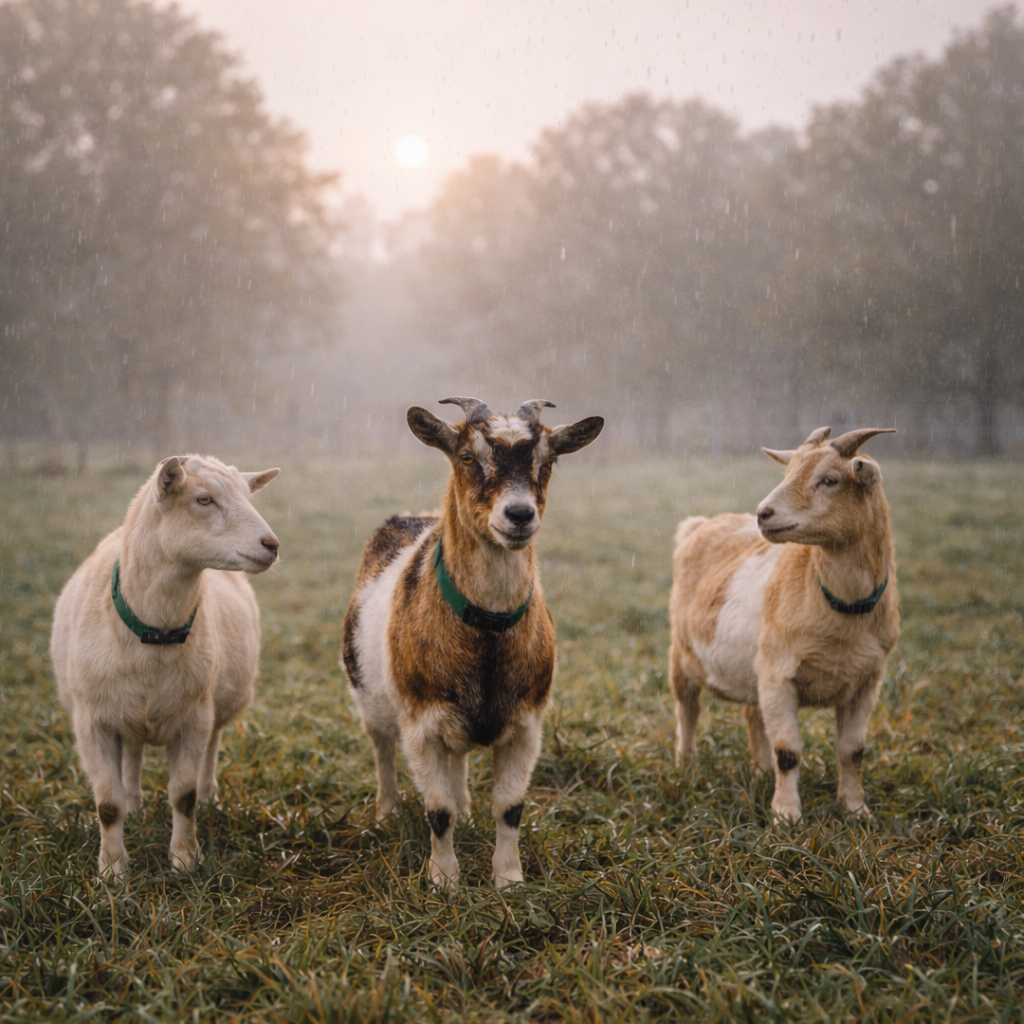
Weather is not treated as background noise but as a meaningful context for health observations.
Notes often reference:
- Heat, humidity, or cold stress
- Wet conditions affecting movement or shelter use
- Seasonal transitions and coat changes
- Changes in appetite related to temperature
Health & Space
Space plays a direct role in how health presents and how quickly changes are noticed.
Large pastures allow goats to:
- Move away from pressure
- Rest without crowding
- Choose shelter or exposure
Feeding & Health Notes
Health notes are cross-referenced with feeding records rather than treated independently.
This includes:
- Recent feed changes
- Mineral consumption patterns
- Changes in browse availability
- Grain or pellet adjustments
Recording Tools & Continuity
Health notes are recorded digitally alongside other records such as feed, pasture, breeding, and weather. This allows observations to be reviewed in sequence and compared across time.
Notes are intentionally plain:
- What changed
- When it changed
- What stayed the same
Illness Prevention Through Attention
Most illness prevention in our setting occurs upstream of diagnosis. Clear baselines and consistent observation reduce the likelihood of sudden surprises.
Early noticing allows for:
- Timely professional consultation
- Targeted response rather than broad intervention
- Reduced stress for both goats and caretakers
Quarantine & Temporary Separation
When new animals arrive, or when an existing goat shows signs that warrant closer observation, temporary separation is used to reduce unnecessary exposure while preserving routine as much as possible. Quarantine in our setting is not treated as an emergency response but as a period of focused observation, during which appetite, movement, posture, social behavior, and recovery are noted in a quieter, more controlled context. Separation allows changes to be tracked without the added variables of herd pressure or competition, while also limiting the spread of issues that may not yet be fully understood. Records from these periods are compared against established baselines and reintegrated into the broader health record over time, with professional consultation sought when appropriate.
Responding Without Urgency
Not every change requires immediate action. Many notes document variation that resolves without intervention.
By recording first and responding later, we avoid:
- Overreaction to transient changes
- Unnecessary disruption of routines
- Compounding stress
Longitudinal Value
Over months and years, health notes become one of the most valuable records on the farm. They reveal:
- How goats age
- How seasons affect behavior and condition
- Which changes repeat and which do not
Limits & Scope
This page documents how health is observed and recorded in our setting. It does not provide guidance for diagnosing or treating illness and should not be used as a substitute for professional care.
What is described here reflects our land, herd structure, climate, and management choices. Other settings may require different approaches.